

Derivation of scientific name – It is not known what the genus and species names refer to.
Common names: Brandwurm (Afrikaans referring to caterpillar stage); Molopo moth/mot (English and Afrikaans); Kweena (Tshwana referring to cocoon/pupal stage)
The African wild silk moth is a remarkable insect. The mature caterpillar, protected by spines that can cause irritation, spins a strong silken cocoon to protect the immobile pupa until it is ready to emerge as an adult moth. During construction these spines are incorporated into the cocoon wall to give the appearance of a little porcupine. Sporadically this species can also undergo a population explosion causing the defoliation of their host plant, resulting in bare trees covered in cocoons. What is also remarkable is that it is possible to produce economically useable and highly prized silk from these cocoons.
Description/How to recognise an African Silk Moth
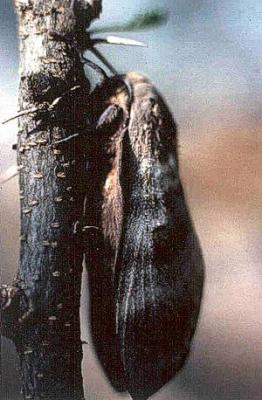
The adult females are dark to light brown and fold their wings over the top of their body to almost form a tent-like structure with their wings. The abdomen is large and cylindrical containing many eggs. Males are about half the length of the females and with thinner body proportions. All the caterpillar instars (stages) have spines that can cause irritation and which look like hairs alternating between brown, white and black in colouration. The cocoons are white and covered by black spines on the outside, but they are smooth and light brown on the inside. The pupa inside the cocoon is dark brown. Cocoons from which moths have emerged (we can tell this by the vase-like hole on one end) remain on the tree and start to yellow in colour and shrivel as the cocoon ages.
Getting around
Adult moths are able to fly, with males flying more easily due to not having the burden of carrying eggs. Caterpillars are able to crawl to different parts of their host plant in the search for foliage.
Communication
Male moths have plume-like antenna to detect the pheromones released by female moths to ensure males find them to mate.
Distribution
The silk moth occurs in the savannas of southern and eastern Africa. In South Africa it is common in the Northern Cape and North West provinces.
Habitat
The African silk moth occurs in Acacia-tree dominated savanna landscapes, particularly in drier parts where outbreaks (population explosions) can occur sporadically. Cocoons are usually found on the branches of Acacia trees.

Food
Hosts plants include Acacia erioloba, A. tortilis, A. melifera, Burkea africana, Brachystegia spp. and the alien Prosopis glandulosa. Caterpillars will stay on the same tree on which the eggs they hatched from were laid, unless there is a large number of them and the tree is completely defoliated before they complete their larval stage.
Sex and life cycles
Sex
Moths reproduce sexually with the larger female (containing about 200 unfertilised eggs in her body) attracting smaller male moths, which can fly more easily, with pheromones. Adults have non-functional mouthparts and are short lived, with all required resources gathered during the caterpillar phase. After mating fertilised eggs are laid on the food plant by the female. The eggs hatch after about two weeks, followed by five larval stages that last about two months in total. The pupa is the longest stage in the life cycle and allows the insect to overwinter and wait for new leaf resources to be available in Spring.
Family life: Eggs are laid in clumps and after hatching small caterpillars tend to aggregate together but become solitary as they grow and age.
The big picture
The African silk moth is an important species in Acacia tree habitats, converting plant matter into nutrients that are made available to other animals and plants in the form of food for predators or frass or faeces that fertilise the soil around the host tree.
Friends and foes
The silk moth has natural enemies such as parasitic flies and wasps that lay their eggs on the caterpillar and then feed off its resources until it spins a cocoon and pupates. These parasites then safely develop in the cocoon and emerge as adult flies or wasps.
Smart strategies
The ability to construct a tough cocoon generally protects the insect from the natural elements and generalist predators for a large part of the life cycle.
Poorer world without me
This silk moth is an important herbivore of Acacia trees, allowing cycling of nutrients as frass that is produced by the caterpillar and can fertilise the soil. The silken cocoon is also an impressive construction made by the insect which can be used to produce indigenous wild silk.
People & I
Caterpillars and cocoons should not be handled as the spines causes skin irritation, with repeated contact usually increasing the severity of any allergic response.
The process of turning these cocoons into silk is not only complex, but there is also a large constraint on the availability of cocoons to harvest to make silk production economically feasible.
Conservation status and what the future holds
With any species that produces a valuable commodity, there is the danger of over-utilisation. Currently, only cocoons from which moths have emerged are collected to ensure that natural populations are not negatively impacted. In future it may be possible to farm this species by seeding Acacia trees, allowing higher abundances for harvest. Research will however first be required to develop the methods to do this and evaluate any subsequent environmental consequences.
Relatives
There is one other Gonometa species in Southern Africa, Gonometa rufobrunnea that feeds exclusively on Mopani trees.
Scientific classification:
Phylum: Arthropoda
Class: Insecta
Order: Lepidoptera
Family: Lasiocampidae
Genus: Gonometa
Species: postica (Walker)
References and further reading
- Veldtman, R. 2005. The ecology of southern African wild silk moths (Gonometa species, Lepidoptera: Lasiocampidae): consequences for their sustainable use. PhD thesis, University of Pretoria, Pretoria.
- Veldtman, R., McGeoch, M.A. & Scholtz, C.H. 2007. Can life history and defence traits predict the population dynamics and natural enemy responses of insect herbivores? Ecological Entomology 32, 662-673
Author: Ruan Veldtman
SANBI – KABR/ECOS
December 2013