
Derivation of scientific name
The Latin specific name ‘scita’ can be translated to ‘neat’ or handsome’ (Hockey et al. 2005). This may be a reference to the flawless smoothness of the feathers and the perfection of the markings. The English common name ‘flycatcher’ refers to its feeding strategy of darting out from a perch or tree branches to catch flying insects in the air and returning to the perch to feed. The Afrikaans common name ‘Feevlieëvanger’ refers to its restless and constantly moving behaviour among tree branches.
The Fairly Flycatcher is a seasonal migrant bird that is endemic to southern Africa, occurring in Botswana, South Africa, Lesotho and Namibia with marginal populations in Swaziland and Zimbabwe. It migrates between Karoo scrub and fynbos areas in the south in summer to thorn scrub areas in the north in winter. It is easily recognisable by its distinctive grey, black and white plumage with a pinkish wash on the chest and belly.
It feeds predominately on flying insects, which are caught in the air by darting out a short distance from a perch and then returning to the perch to feed, a foraging technique known as fly catching from which the species partly derives its common name. It is currently listed as Least Concern by the IUCN Red List, although habitat fragmentation is regarded as a potential threat.
How to recognise a Fairy Flycatcher
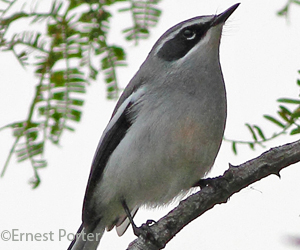
The Fairy Flycatcher is a small bird (11 cm, 6 g) that has a characteristic grey, black and white plumage with a pinkish wash on the chest and belly. It has a striking black face mask that contrasts with a white eyebrow line. The wings are black, with a white stripe and the lower back and tail are also black with white outer tail feathers. It has a slender and elegant shape, with fairly long legs.
Getting around
While feeding, the movements are quick and constant. The tail may be fanned and the wings lowered at times. It usually remains within the tree canopy or moves from bush to bush and does not usually fly higher than 7 m or more than 50 m at a time.
Communicating
A quiet ‘tzzzzzz’ is all you might hear to alert you to its presence in its thorn veld, non-breeding habitat. Though often silent, it has been recorded singing a soft, sweet, melodic little song interspersed with a buzzing ‘tzzzzz’. There are apparently different versions of the song, but their functions are not yet known.
Distribution
It is endemic to southern Africa; occurring in Botswana, South Africa, Lesotho and Namibia with marginal populations in Swaziland and Zimbabwe. In South Africa, it is widespread in many areas although it seems to avoid the eastern coastal areas and the Mpumalanga Escarpment.
Habitat
During the summer breeding season, the Fairy Flycatcher prefers dry, shrubby areas and scrublands, fynbos, succulent Karoo, dry valley thickets, thorn thickets and grasslands. Nests are well hidden inside the tangled branches of small trees or shrubs. Currant bushes (Searsia species), honey thorn (Lycium oxycarpum), some thorn tree (Vachellia or Senegalia) species and various mistletoes have been recorded as preferred nesting sites. Mountain gonna (Passerina montana) is used as a nest site in Lesotho. In winter, Fairy Flycatchers migrate to areas of dry savanna, plantations, gardens in rural areas, thorn veld and subtropical high altitude shrub lands.
Food
Prey is predominately insects and other small invertebrates. Flies, true bugs, small beetles, wasps, bees, ants and spiders have been recorded as food items. Flower heads of some tree species are worked over to catch small insect visitors, and possibly spiders, which also prey on flower-visiting insects.
SEX and LIFE CYCLES
Sex
Fairy Flycatchers are monogamous (a breeding pair stays together for the breeding season), territorial, solitary nesters. Courtship feeding behaviour has been observed and recorded on one occasion in Lesotho. Nests are built solely by the female and are placed well away from neighbouring pairs. The nest is cup-shaped and may be camouflaged by lichens or bark. Nest building takes about four days and involves the use of fine pieces of plant matter and fibres glued together with spider web, and soft plant material or animal hair are used to line the nest.
The nest is well concealed in tree branches and is placed about a metre above ground. In summer rainfall areas, the main egg-laying months are October–November, while August–September is the important egg-laying period in winter rainfall areas. Fairy Flycatchers lay 2–3 eggs and incubation lasts 13–16 days. Incubation is performed solely by the female while the male forages and provides the incubating female with food. Parental care of the hatched young is also performed by the female and chicks may stay in the nest for 15–17 days after hatching.

THE BIG PICTURE
Friends and Foes
Common predators include the boomslang, an arboreal (= lives in trees) snake species that feeds on passerine (= perching bird) adults, young and eggs. Other predators include small- to medium-sized snakes that only feed on eggs, small raptors such as sparrowhawks, and shrikes and coucals that also prey on nestlings and eggs. Nocturnal mammals such as genets that are adept tree climbers will take roosting birds if they can. In the more southern parts of the distribution, the Fairy Flycatcher is frequently seen with the similar-sized Pririt Batis (Batis pririt), while it often keeps company with Chinspot Batis (Batis molitor) in the northern parts of its range. It is thought that feeding in a group provides additional vigilance and therefore safety, which then outweighs any potential competition for prey.
Smart Strategies
The cryptic and well-hidden nest affords some protection from predators.
Poorer world without me
The full effect of the decline of insectivorous birds is not yet known and may have indirect consequences on ecosystems.
Conservation status and what the future holds
The current IUCN Red Listing category is Least Concern, though habitat fragmentation is regarded as a potential threat.
Relatives
The taxonomy of flycatchers has been difficult to resolve because members of this family display both warbler and flycatcher-like characteristics. The equivocal characteristics include unmarked tongue of the nestlings, food begging calls of the female and fanning of the tail, which are typical of flycatchers, while much of the feeding behaviour is characteristic of warblers. Three subspecies of Stenostira scita are recognised based on the lightness or darkness of the grey colouration and also on size.
These are: Stenostira scita scita, which breeds in northwestern parts of the region and overwinters in southern Namibia and Botswana, Stenostira scita rudebecki, which occurs in more northern and eastern parts of South Africa and overwinters in Gauteng and Highveld areas. Lastly, Stenostira scita saturatior occurs in central, southern and eastern parts of South Africa but spends the winter period in western parts of Free State.
Scientific classification
Name: Stenostira scita (Vieillot, 1818)
Kingdom: Animalia
Phylum: Chordata
Class: Aves
Order: Passeriformes
Family: Silviidae
Genus: Stenostira
Species: S. scita
Common names: Fairy Flycatcher, Feevlieëvanger (Afrikaans)
References and further reading
- Alexander, G. & Marais, J. 2007. A guide to the reptiles of southern Africa. Cape Town. Struik.
- BirdLife International, 2014. IUCN Red List for birds. Downloaded from http://www.birdlife.org on 08/05/2014.
- Ginn, P.J., McIlleron, W.G. & Milstein, P. le S. 1996. The complete book of southern African birds. Struik, Cape Town.
- Hockey, P.A.R., Dean, W.R.J. & Ryan, P.G. (Eds.) 2005. Roberts – Birds of Southern Africa, VIIth ed. The Trustees of the John Voelcker Bird Book Fund, Cape Town.
- Iziko Museum of Cape Town. Biodiversity Explorer The Web of Life in Southern Africa. Stenostiria scita (Fairy Flycatcher) Downloaded from http://www.biodiversityexplorer.org/birds/sylviidae/stenostira_scita.htm on 08/05/2014.
- Maclean, G.L. 1990. Ornithology for Africa: A text for users on the African continent. University of Natal Press, Pietermaritzburg
- Roberts VII names database version 2005.10.31. From website: http://www.fitzpatrick.uct.ac.za/docs/robdata.html.
- Sekercioglu, C.H. 2006. Increasing awareness of avian ecological function. Trends in Ecology and Evolution 21,8: 464–471.
- Sinclair, I., Hockey, P. & Tarboton, W. 2002. Sasol Birds of Southern Africa. Third Edition. Cape Town. Struik.
- Tarboton, W. 2001. Nests and Eggs in southern African Birds. Struik, Cape Town.
Author: Alice Aubrey
Walter Sisulu National Botanical Garden
August 2014