

Derivation of scientific name
Bradypodion is derived from Latin and means ‘slow-footed’.
Common names: Little Karoo dwarf chameleon, Robertson dwarf chameleon.
The Little Karoo dwarf chameleon is one of 15 currently identified dwarf chameleons that are endemic to South Africa. The Little Karoo dwarf chameleon is a small-sized species that changes colour as a method of communication, for defence and in response to environmental stimuli such as light and temperature. It is arboreal, living among trees and shrubs. Like other dwarf chameleons, it is ovoviviparous, which means that it gives birth to live young – in this case 10 to 15 young per litter. The current conservation status of the Little Karoo dwarf chameleon is Least Concern (LC), but because of its small and restricted range, it is becoming increasingly threatened by habitat loss and habitat fragmentation from changes in land-use patterns, mainly because of agriculture.
How to recognise a Little Karoo dwarf chameleon
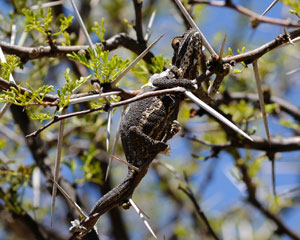
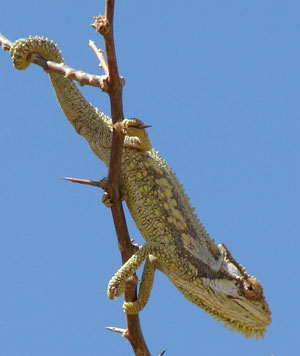
The Little Karoo dwarf chameleon is a small species (80–150 mm in length) with a characteristic olive-grey body colour with brown and orange patterns. They have a well-developed casque, which is the raised structure on the back of the head. The gular crest along the midline of the lower jaw has pointed gular scales that are longer than wide. This character is often used to identify this species. The dorsal crest in the Little Karoo dwarf chameleon extends along the entire length of the body and halfway along the tail. They have enlarged tubercles along the flanks, which can be brown, green, orange or red. Their large turret-like eyes can move independently of each other and give almost a 360 degree view of their surroundings. The feet have five toes, each with a prominent claw. There are three toes on one side and two on the other, allowing a firm grip on thin branches.
Getting around
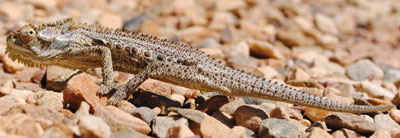
The Little Karoo dwarf chameleon is mostly arboreal, spending most of their time in trees or shrubs, but will occasionally move on the ground between shrubs. Their movement is slow, rocking backwards and forwards as they are walking.
Communication
Little Karoo dwarf chameleons communicate through their posture, colouration, head bobbing and displaying of the inside of their mouths. When threatened, it will turn dark, blow itself up and open its mouth to display the orange inside. It may also hiss and lunge forward to dispel a potential threat. Males display brighter colours to get the attention of receptive females. If the female is not receptive she will be very aggressive, but when she is willing she will be calm and display brighter colours.
Distribution
Previously it was believed that the Little Karoo dwarf chameleon was restricted to the Robertson–Worcester region, but research has revealed that they have a much wider distribution. The Little Karoo dwarf chameleon occurs in the Little Karoo and surrounding Cape Fold Mountains, from the west of southern Cederberg to near Uniondale in the east, and from Robertson to the De Hoop Nature Reserve in the south.
Habitat
The Little Karoo dwarf chameleon occurs in the drier regions of the Western Cape and is found in drier Fynbos, Renosterveld and in the Fynbos–Succulent Karoo transition zone.
Food
Little Karoo dwarf chameleons mostly find their food through a sit-and-wait method to ambush insects or by walking around on the vegetation in search of food. The diet mainly consists of insects like flies, crickets, grasshoppers, butterflies, beetles and spiders. Water is also essential in their diet and chameleons get most of their water from dew or rain drops on the plants.
Sex and life cycles
Dwarf chameleons lack sexual dimorphism. The males and females are the same size and the only way to differentiate is to look closely at the tail, which has a broader base in the male than in the females. Chameleons generally have a short life span of three to five years. The Little Karoo dwarf chameleon is ovoviviparous, meaning that the fertilised eggs remain inside the body until they are ready to hatch and the female gives birth to live young. Mating occurs in spring and females give birth to 5–20 young per litter and may deliver two to three litters per season. The gestation period is about three months and the young are about 2 cm in size at birth.

Family life
Dwarf chameleons are solitary, but during breeding season they will tolerate each other. When the babies are born, they are immediately independent and can grasp, climb and feed voraciously on small insects such as fruit flies. Growth is rapid and maturity is reached in nine months. The mother will tolerate the babies for a while until they find their own territory.
The big picture
Friends and foes
The enemies of chameleons are snakes, particularly the boomslang, birds and domestic animals. The Fiscal Shrike often pins chameleons on a thorn. Other birds that prey on chameleons are goshawks, sparrowhawks, egrets, herons and storks. Spiders will sometimes feed on the baby chameleons.
Friends are the people who do not use insecticides and have indigenous gardens that provide enough cover and food sources to attract chameleons.
Smart strategies
Chameleons have very specialised feeding and locomotion behaviours. They have laterally compressed bodies, prehensile feet and tail, well-developed eyesight and a long projectile tongue to catch their prey. The eyes can move independently from each other and this helps them to spot prey or danger. Chameleons are also well known for their ability to change colour.
Poorer world without me
Chameleons are an important insectivorous predator.
People and I
Chameleons are popular pets, and as a result have been widely moved to areas outside their natural range. In South Africa it is illegal for people to capture and trade in indigenous chameleons or have them as pets without a valid permit. Chameleons are harmless, but may bite when threatened. Some African cultures also fear chameleons and will kill them when they find one.
Conservation status and what the future holds
The current conservation status of the Little Karoo dwarf chameleon is Least Concern (LC), but because of its small, restricted range, the species is becoming increasingly threatened by habitat loss and habitat fragmentation from changes in land-use patterns because of agriculture. Other conservation threats to chameleons include veld fires and use of insecticides.
Relatives
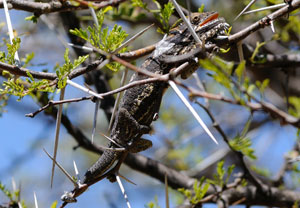
The family Chameleonidae contains 197 known species of chameleons, which are found on the southern Arabian Peninsula, in southern Europe, southern India and Sri Lanka, as well as in Africa and on its associated islands such as the Seychelles and Comoros Islands. The family is divided into 11 genera of which three are endemic to Madagascar (Brookesia, Calummana, Furcifera) and one to the Seychelles (Archaius). Seven genera (Bradypodion, Chamaeleo, Kinyongia, Nadzikambia, Rhampholeon, Rieppeleon and Trioceros) are found on the African continental main land. The dwarf chameleons belong to the genus Bradypodion, which is composed of 17 known species, 15 of which are endemic to South Africa. The species in this genus all have small and restricted natural ranges.
Scientific classification
Name: Bradypodion gutturale (Smith, 1849)
Class: Reptilia
Order: Squamata
Family: Chamaeleonidae
Genus: Bradypodion
Species: B. gutturale
References and further reading
- Alexander, G. & Marais, J. 2007. A guide to the reptiles. Struik Publishers, Cape Town.
- Jacobsen, N. 2005. Remarkable reptiles. Briza, Pretoria.
- Tolley, K. & Burger, M. 2007. Chameleons of southern Africa. Struik Publishers, Cape Town.
- Wagner, A.1983. The life of the chameleon. Wildlife Society, Durban.
- Tolley, K.A. 2014. Chamaeleonidae. In M.F. Bates, W.R. Branch, A.M. Bauer, M. Burger, J. Marais, G.J. Alexander & M.S. de Villiers (eds). Atlas and Red list of the reptiles of South Africa, Lesotho and Swaziland. Suricata 1. South African Biodiversity Institute, Pretoria
Author: Lize Wolfaardt
Karoo Desert National Botanical Garden
May 2014