

Nuttalliella namaqua is the sole tick species of the monotypic genus and family Nuttalliella and Nuttalliellidae respectively, and it is presumed to be a living fossil closest to the ancestral tick lineage as well as the missing link between the Ixodidae and Argasidae families, since it possesses features that are unique to either hard or soft ticks (Bedford 1931).
Description/How to recognise a…
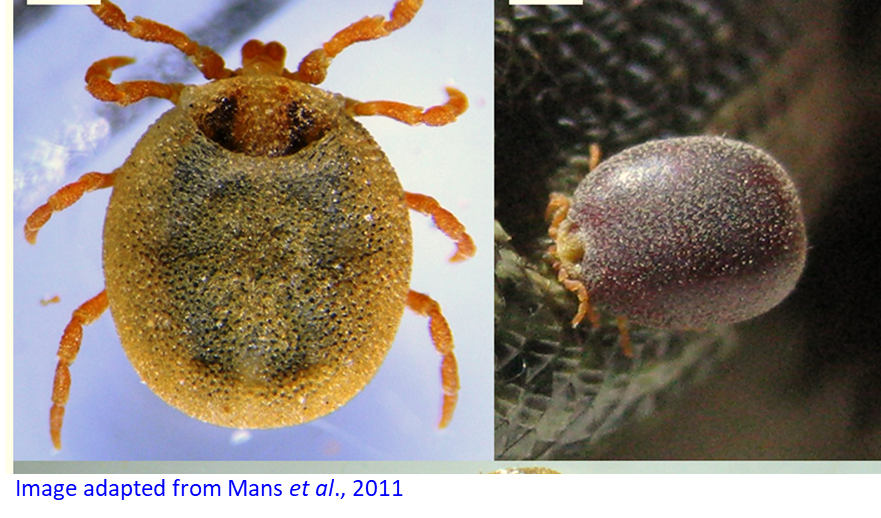
The species has several unique features, which include palpi with only three segments as well as leg segments that are joined by ball-and-socket joints, which are especially noticeable in nymphs an adults. Nymphs and adults of this species have a dorsal pseudo-scutum similar to that of hard ticks, but a wrinkled cuticle with elevations and pits, similar to soft ticks (Bedford 1931; Mans et al. 2011), while the larvae has a true scutum that resemble that of hard ticks (Latif et al. 2012). In addition, these authors also indicated that the scutum of N. namaqua males covers most of their dorsal side like the males of the hard ticks.
Getting around
Nuttalliella namaqua is a crawler. As one of the acarines, it has six legs in the larval stage and eight legs in the nymph and adult stages.
Communicating
They do not make any noticeable sound.
Distribution
Nuttalliella namaqua is an African species. It has been reported from various African countries, including Tanzania, Namibia, South Africa, Mozambique and Botswana. Its distribution in South Africa includes the Soutpansberg, Limpopo; Plaatfontein Farm, Northern Cape (Horak et al. 2012); Graaff-Reinet, Eastern Cape; Namaqualand, Northern Cape, and Heuningvleipan, North West (Mans et al. 2011, 2012).
Habitat
The species prefers mixed tree and shrub savanna, and rocky high rainfall areas. It has been collected from different sites such as open ground, under stones, in birds’ nests as well as in rock crevices (Mans et al. 2011).
Food
Nuttalliella namaqua feeds on blood from its hosts. It has the ability to feed intermittently and store the blood-meal for long periods of time.
Sex and life cycle
Sex: Before the description of the first male of the species, Nuttalliella namaqua was presumed to be parthenogenetic as most tick species are bisexual. However, two pairs collected from Springbok, Namaqualand in South Africa, were found in mating positions and were confirmed to consist of a male and female each (Mans et al. 2011).
Despite the species being described over 90 years ago, its life cycle is still not well defined. Its hosts preference is also not clear, however, it has been speculated to be a generalist as specimens have been collected from different host species, including murid rodents, meerkats and reptiles, and the habitats they were found include open ground, bird nests, rocks and rock crevices. Laboratory feeding of nymphs and females on mice, rats, pigeons, chickens and rabbits was unsuccessful (Mans et al. 2011).
Family life: Only individual specimens, mostly females, have been collected from different localities. Moreover, previous reports were mostly on females and larvae of this species, while males have only been described recently by Latif et al. (2012).
THE BIG PICTURE
Friends and Foes
Based on collection sites, this species prefers a wide range of hosts but mostly those dwelling in rocky areas like reptiles (especially lizards), rodents, rock hyrax and most burrowing mammals. They also serve as food to some birds and reptiles.
Smart Strategies
Nuttalliella namaqua is reported to be a generalist, as it is able to adapt and parasitise multiple hosts, including burrowing mammals and reptiles. This behaviour allows this species to survive when some host species becomes extinct.
Poorer world without me
Ticks are generally indicators of ecosystem health and stability. An increase in tick populations may indicate a decrease in the predators of small mammals such as snakes. They also serve as food to some birds and reptiles. Some tick metabolites are a source of biochemicals with medicinal uses.
People & I
Currently, the pathogenicity of this tick species is still not clear as it has not been associated with any zoonotic pathogen, yet it can’t currently be ruled out that it might transmit pathogenic pathogens to humans.
Conservation status and what the future holds
The conservation status of this tick species is not clearly defined yet; hence it is not listed on the IUCN Red List.
RELATIVES
Nutalliella namaqua is the only species in the genus and family, Nutalliella and Nuttallielidae, respectively. Its features indicates that it is more closely related to the genus Ixodes in the family Ixodidae than any other genus or family. Bedford (1931) indicated that this tick species was a notable so-called missing link in the evolutionary chain between the Ixodidae and Argasidae families. This was also supported but the recent findings by Mans et al. (2012, 2014) that indicated that the three tick families are phylogenetically distinct with Nuttalliellidae on the basal position. Moreover, both these authors also presumed that the existence and collection of this species in southern African localities, is an indication that the Ixodidae may have originated in Africa.
Scientific Name and Classification:
Kingdom: Animalia
Phylum: Arthropoda
Class: Arachnida
Order: Ixodida
Family: Nuttalliellidae
Genus: Nuttalliella
Species: N. namaqua Bedford, 1931
Derivation of scientific name ( if known):
The genus (Nuttalliella) and family (Nuttalliellidae) names were given as an honour to the bacteriologist George Nuttall, who was a specialist in tick-borne diseases; while the species name was given based on the site (under a stone at Kamieskroon, in Little Namaqualand) where the first described species of this genus was collected (Bedford, 1931).
References and further reading
- Apanaskevich, D.A. 2021. New larval host records and locality data for Nuttalliella namaqua Bedford, 1931 (Acari: Nuttalliellidae). Systematics and Applied Acarology, 21(1). https://doi.org/10.11158/saa.26.1.18
- Bedford, G.A.H. 1931. Nuttalliella namaqua, a new genus and species of ticks. Parasitology 23(2): 230–232. doi:10.1017/S0031182000013573.
- Keirans, J.E., Clifford, C.M., Hoogstraal, H. & Easton, E.R. 1976. Discovery of Nuttalliella namaqua Bedford (Acarina: Ixodoidea: Nuttalliellidae) in Tanzania and redescription of the female based on scanning electron microscopy. Annals of the Entomological Society of America, 6(5).
- Latif, A.A., Putterill, J.F., De Klerk, D.G., Pienaar, R. & Mans, B.J. 2012. Nuttalliella namaqua (Ixodoidea: Nuttalliellidae): first description of the male, immature stages and re-description of the female. PLoS ONE 7(7): e41651. doi:10.1371/journal.pone.0041651
- Mans, B.J., De Klerk, D., Pienaar, R. & Latif, A.A. 2011. Nuttalliella namaqua: A living fossil and closest relative to the ancestral tick lineage: implications for the evolution of blood-feeding in ticks. PLoS ONE 6(8): e23675. doi:10.1371/journal.pone.0023675
- Mans, B.J., De Klerk, D., Pienaar, R., De Castro, M.H. & Latif, A.A. 2012. The mitochondrial genomes of Nuttalliella namaqua (Ixodoidea: Nuttalliellidae) and Argas africolumbae (Ixodoidae: Argasidae): estimation of divergence dates for the major tick lineages and reconstruction of ancestral blood-feeding characters. PLoS One 7: e49461.
- Mans, B.J., De Klerk, D.G., Pienaar, R. & Latif, A.A. 2014 The host preferences of Nuttalliella namaqua (Ixodoidea: Nuttalliellidae): a generalist approach to surviving multiple host-switches. Experimental and Applied Acarology, 62, 233–240. https://doi.org/10.1007/s10493-013-9737-z
- Oliver, J.H., Jr. 1989. Biology and systematics of ticks (Acari: Ixodida). Annual Review of Ecology and Systematics, 20, 397–430. doi:10.2307/2097098
Author: Dr. Maphuti Ledwaba
Organisation: SANBI
E-mail: M.Ledwaba@sanbi.org.za