

Derivation of scientific name: The genus name Tilapia is derived from the Sotho word for a fish “Thlape”. The specific epithet “guinasana”, from Lake Guinas near Tsumeb, Northern Namibia.
Common names: Nguni fish, African Koi, hlampfi (Xitsonga).
The Otjikoto Tilapia is a rare endemic fish species from Northern Namibia. This attractive species is easily distinguished from other Tilapias by its variable, mottled coloration in the adults. It originates from a solitary small dolinen sinkhole lake in Northern Namibia but it has been translocated to adjacent water bodies. This fish, due to its ornamental value, shows potential for garden ponds and aquaria.
Description (partially based on Skelton 1993)
This is a small fish, 90-140 mm long, relatively deep bodied, and ovoid with 13-24 dorsal spines. The mouth is small, and bears finely divided (bicuspid) teeth in three rows. The colour is very variable; the young fish are olive green with eight to nine vertical dark bars, and three faint horizontal bars as well as a darker spot at the base of the soft dorsal fin (typical of Tilapia). The adult colouration, ranges from light to dark blue, blackish, yellowish or olive green to almost entirely off-white pinkish, and the fins are often white with dark spots, and sometimes the fins are red streaked. Breeding pairs have a dark throat, abdomen and anal fin (during summer). The fins are sometimes iridescent green or bluish.

Distribution
The Otjikoto Tilapia is endemic to Lake Guinas near Tsumeb in central northern Namibia. More recently it was translocated to other water bodies such as the adjacent Lake Otjikoto and farm dams. Lake Guinas and Otjikoto are open sinkholes in dolomite rock formations. It has also been spread by aquarists and can be found in aquaria in Europe and the USA.
Habitat
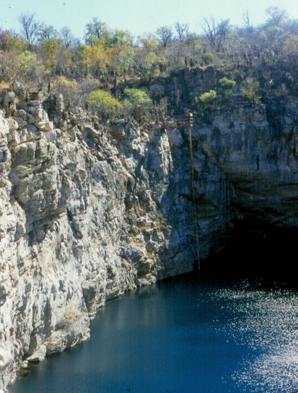
The Guinas dolinen (open water filled sinkhole) is about 119 m deep and 140 x 70 m with sheer cliffs. The water is clear and remarkably blue in colour. The fish occurs in shoals and can be seen from above. The vegetation in the region consists of savannah with Acacia tortilis, Dicrostachys cinerea, Combretum imberbe, C. apiculatum, Spirostachys cinerea and Terminalia prunoides, The Windhoek aloe (Aloe littoralis) occurs on the ledges together with another smaller succulent, Stapelia schinzii. The average rainfall is about 500-550 mm per annum and occurs roughly during summer (from the end of October to April). The climate is hot during summer and winter but with cold nights during winters. The water temperature is estimated to be about 18 degrees in winter and about 25 degrees during summers. Once the breeding season commences (November to May), males and females pair off selecting breeding sites along ledges of the vertical dolomite walls. The dolomite forms part of the Damara Supergroup and Gariep Complex and belongs to the 700 million year old limestones of the Otavi Group. This is a typical karst lake, and due to the dolomite, the pH of the water is high (hard water).
Food
The main food is algae from the dolomite walls and diatoms. However, this omnivorous species is opportunistic and can be voracious feeders. A population in captivity at Kirstenbosch will take insects, larvae, worms, and general fish food.
Life cycle
Spawning occurs during summer with rising temperatures when a male and female leave the shoals and form a tight pair-bond, and develop the dark breeding colouration on the lower portion of the throat, abdomen and anal fin. The breeding site consists of ledges of the vertical dolomite sinkhole walls. Females lay their eggs which are then fertilized by the male, and both parents tend and guard the nests. They become aggressive to any intruder that approaches the nest. The eggs and larvae are fanned regularly and may be moved by the parents. Parental care and protection from both parents continue until the young fish are eventually weaned. The young remain close to the parents. Males and females will take turns to forage whilst one of the pair remains to protect the young. The young fish are fast growing and reach sexual maturity within a year.
Family life: – They occur in shoals when not breeding.
The big picture
Tilapia guinasana evolved in a solitary lake devoid of predators and competition from other fish. This is thought to be the main reason why it lost control over camouflage. The other reason could be that the ancestor washed into the subterranean waterbody (water filled cave, before the roof collapsed), and like other cave-dwelling fish suffered a loss of pigment, which can perhaps explain the light coloured pinkish colour of some fish.
Tilapia guinasana is a habitat specialist, and successful breeding depends on a high pH (hard water), and rocky ledges (in the absence of predators). As it competes with other fish, and due to its lack of camouflage, it is easily picked out by predatory birds or other fish species. Therefore, due to its sensitive habitat requirements it is unlikely to became an invasive species such as its close relative the banded Tilapia or Vleikurpur (Tilapia sparrmanii). Tests at Kirstenbosch show that T. guinasana does not thrive in local acidic water. Dolomitic lime or limestone must be added to the water to raisie the ph.
The Vleikurper (T. sparrmanii) is indigenous to the northern parts of southern Africa is a generalist. It is a highly invasive species, and is a threat to local species (Picker & Griffiths 2011). The two other southern African Tilapia species are the redbreast Tilapia (T. rendalli) (north-eastern parts of South Africa) and the Okavango Tilapia (T. ruweti) (Okavango basin).
Conservation status and what the future holds
The Otjikoto Tilapia is Endangered, because of its restricted distribution and other fish introduced to its original habitat at Lake Guinas. However, due to the relative ease with which it can be bred and its popularity as a pond fish, it is well established and in no danger of immediate extinction in terms of ex situ conservation. Regular water extraction from both Lake Guinas and Otjikoto is greater than the annual rainfall input which results in a lowering of the water table.
Tilapia guinasana holds potential as an indigenous African pond fish. It also holds breeding potential due to its different colour forms. They make excellent pond fish and are great to watch during their breeding season when they are caring for their young. Due to its conspicuous nature (lacking in sufficient camouflage), it should be protected from predatory birds. It would make a good indigenous alternative to the exotic goldfish or Koi pond in Namibia and South Africa.
When I was confronted with choosing a suitable indigenous species for the pond between the Botanical Society Conservatory and Visitor Centre which was constructed just after the inauguration of the Conservatory in 1996, I chose T. guinasana (from the 245 other indigenous fish species in southern Africa) due to its ornamental value and relative ease of keeping and because it is a non-invasive species. Additional favourable qualities are its visibility (conspicuous ornamental colouration), and secondly relative hardiness. Adult Otjikoto Tilapia fish have a variable mottled colour pattern not unlike Nguni Cattle, hence the other common name Nguni Fish. Most other southern African fish are well camouflaged or require specialist breeding facilities and they are thus quite invisible if kept in a pond.
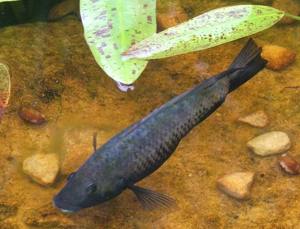
Just more than a dozen T. guinasana were donated by the National Zoological Gardens in Pretoria and placed in the Visitor Centre pool at Kirstenbosch. Gravel was first introduced and eel grass (Vallisneria spiralis) established. This cosmopolitan submerged aquatic is attractive and has stoloniferous growth which forms a mat almost like a submerged lawn. This aquatic plant is essential as it absorbs minerals from the water (which the free-floating algae are dependent on and which make the water murky green). The result is crystal clear oxygenated water, and healthy fish (In the 14 year history of this pond it has never been necessary to replace the water!). We also placed limestone rock at various intervals to raise the pH and to create breeding sites. This was a great success and the few fish rapidly multiplied the first summer. Although the fish thrives at Kirstenbosch, temperatures are lower than in its natural habitat and during very cold mornings some fish may succumb. This is also the case in places such as Windhoek (Namibia), Johannesburg and Pretoria. It is recommended that in cold and very hot areas a deep portion in the pond should be created because here temperature changes will not be so extreme.
Relatives
The genus Tilapia was established by A. Smith in 1840, and Tilapia guinasana is one of 4 indigenous Tilapia species in southern Africa (30 species in Africa), and the only species within the genus Tilapia which has poor camouflage. Tilapia species are substratum spawners unlike their mouth breeding relatives. Both parents care for the eggs, fry and young fish. There are 115 fish species recorded for Namibia, most from the northern river systems (Kumee, Cuvelal, Okavango and Zambezi.
Scientific classification: Tilapia quinasana Trewavas, 1936
Family: Cichlidae
References and further reading
- Grunert,N. U. Namibia- Fascination of Geology.Klaus Hess Publishers, Windhoek.
- Jubb, R.A. 1967. Freshwater Fishes of Southern Africa. A.A. Balkema, Cape Town, Amsterdam.
- Mendelsohn, J. Jarvis, A. Roberts, C, & Robertson, T. Atlas of Namibia. 2009. Sunbird Publishers, Windhoek.
- Picker, M. & Griffiths, C. 2011. Alien and Invasive Animals, a South African perspective.
- Van Jaarsveld, E.J. 2010. Waterwise Gardening. Struik, Cape Town.
- Skelton, P. 1993. A complete Guide to the Freshwater Fishes of southern Africa.Southern Book Publishers
Author: Ernst van Jaarsveld
December 2013