
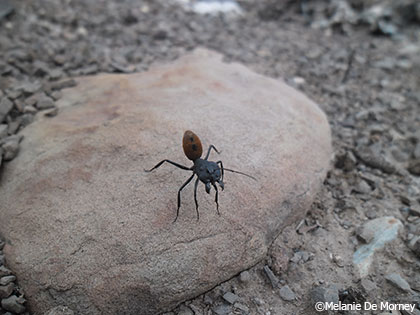
Derivation of scientific name
The species name fulvopilosus is derived from the Latin word fulvus (used as an adjective or variation form, especially when the species is bicoloured and sometimes with one colour extended to the under surface), referring to the yellow-haired sugar ant’s tawny or dark yellow hair.
Introduction
Camponotus fulvopilosus is a beautifully colourful ant species with magnificent eyesight and remarkable presence. It belongs to the family Formicidae and is widely distributed in arid regions of southern Africa, from Angola, Botswana and the Democratic Republic of Congo, to Namibia and South Africa. This species is active during the day and is easy to see, which makes it vulnerable to predators, however, it has an interesting defence mechanism.
Unlike other ants, it is equipped with a special venom gland that produces formic acid. This allows it to use an acid-squirting mechanism against attackers. Members of this species are normally found in a rocky habitat that provides a nice nesting area, under rocks, bushes and fallen trees. Ants have been used in biodiversity studies, since they are good indicators of change in the ecosystem.
Description
The yellow-haired sugar ant is relatively large compared to other ant species; the queen is about 17–18 mm, a miner-worker 9–10 mm, a media worker 11–14 mm and a soldier 15–19 mm). The body is divided into three segments: head, rounded thorax and gaster (abdomen) with dense yellow hair sometimes broken up by three median bare patches. Workers and soldiers can be distinguishing by the size of the head; soldiers have an enlarged head and large pair of mouth parts (mandibles). Workers have slender heads with small mandibles and they don’t sting; they only spray formic acid.

Relatives
Ants are closely related to bees, wasp and sawflies. Ants can be easily separated from bees and wasps, because they have elbowed antennae and a petiole, which is a node-like structure that forms a slender waist. They all belong to the order Hymenoptera and they are the third largest group of insects with over 150 000 species known.
Getting around
They are ground dwelling organisms, and spend most of their time wandering around collecting food and material to build the nest.
Communication
Ants use pheromones (biochemical) to communicate especially when collecting food, by marking the path leading to the food source and back to the nest.
Distribution
The yellow-haired sugar ant is widely distributed in arid regions of southern Africa, from Angola, Botswana and the Democratic Republic of Congo, to Namibia and South Africa.
Habitat
They are normally found in a rocky habitat that provides a nice nesting area, under rocks, bushes and fallen trees.
Food
Sugar ants feed both on insects and honey dew produced by aphids, and some species of plants. Workers forage for food and feed the young ones.
Life cycle
This species has small colonies with one queen per nest. They also have a very short life cycle with only four developmental stages, namely: egg, larva, pupa and adult. Females develop from fertilised eggs and males develop from unfertilised eggs. This also helps them to balance the number of male vs. female offspring.
Sex
During the mating season winged males and winged queens emerge from the nest and mate in flight (nuptial flight). The male dies after mating and the fertilised queen sheds her wings. The queen also selects a location, starts a new nest and lays her first eggs. The eggs go through the developmental stages and eventually worker ants will emerge. All the workers are sterile. The queen will continue to lay eggs and the workers will assist her in caring for the offspring. The queen will continue to lay more eggs for the colony to grow. This system makes them one of the most successful groups of ground-dwelling invertebrates.

Family life:
Sugar ants are a social species and they have different levels of labour division from building the nest and taking care of the offspring.
THE BIG PICTURE
Friends and foes
Ants are at a low level of the food pyramid, so most animals like to eat them and some animals are specialist ant-eaters (myrmecophagy). In South Africa, the greatest enemy of Camponotus fulvopilosus is the invasive argentine ant, Linepithema humile.
Smart Strategies
In terms of food storage, members of the family Formicidae have developed an interesting strategy of using some of the individuals as ‘honeypots’. Honeypot ants are specialised workers that are gorged with food by other workers, causing their abdomens to swell enormously and act as living larders from which other members of the hive can later extract nourishment.
Poorer world without me
Ant colonies are an important component in most habitat types, they assist in nutrient cycling and plant pollination. They are also predators and they help in balancing the trophic levels.
People and I
Ants are common and harmless to humans. However, they can be a nuisance when they come in to the house and start competing for food.
Conservation status and what the future holds
Even though ants have been used as a biodiversity measuring tool, the conservation status of the yellow-haired sugar ant is not known.
Scientific classification
Phylum: Arthropoda
Class: Insecta
Order: Hymenoptera
Family: Formicidae
Genus: Camponotus Mayr, 1861
Species: C. fulvopilosus (De Geer, 1778)
Other common names: intuthwane (isiZulu); Iimbovane (isiXhosa); balbyter (Afr.)
References and further reading
- Picker, M., Griffiths, C.L. & Weaving, A. 2004. Field guide to insects of South Africa. Cape Town: Struik.
Links – accessed
- http://en.wikipedia.org/wiki/Hymenoptera
- http://en.wikipedia.org/wiki/Carpenter_ant
- https://www.ants-kalytta.com/Ants-Africa.html
- http://antsofthecape.blogspot.com/p/formicinae-very-large-sugar-ants.html
- http://www.ispotnature.org/species-dictionaries/sanbi/Camponotus%20fulvopilosus
Author: Thembile Khoza
Biosystematics (SANBI)
July 2015