
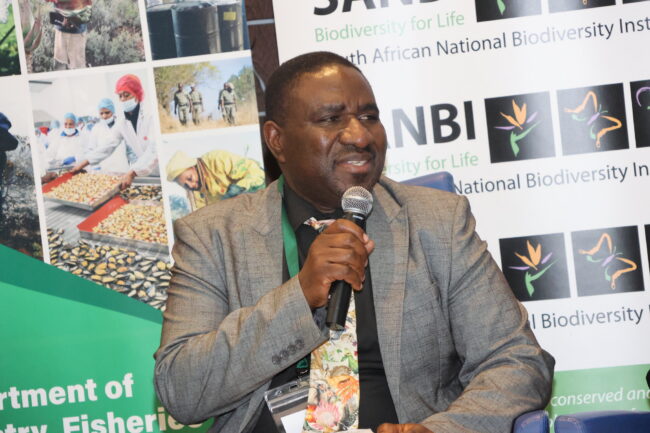
Chief Executive Officer, Shoni Munzhedzi addresses Biodiversity Credits event at Walter Sisulu National Botanical Garden in Roodepoort, Gauteng
Programme Director,
Distinguished speakers,
Colleagues and partners.
As we conclude today’s South African Dialogue on Nature Credit Markets, I would like to thank all our speakers, panellists and participants for a very important and timely conversation.
This dialogue comes at a particularly important moment for South Africa. We are finalising our third-generation National Biodiversity Strategy and Action Plan, together with the Biodiversity Finance Plan, which provides a roadmap for diversifying and increasing the financial resources available for biodiversity implementation.
Within this broader biodiversity finance agenda, voluntary nature markets are being explored as part of the suite of innovative and positive finance solutions that could mobilise additional private-sector resources for biodiversity. The NBSAP similarly identifies instruments such as biodiversity credits, alongside other innovative finance mechanisms, while emphasising the importance of environmental and social safeguards.
For SANBI, therefore, this conversation is not happening in isolation. It connects directly with several initiatives already under way.
Through the CAP4NATFIN FEXTE project, funded by AFD and implemented through the partnership between SANBI and the French Biodiversity Agency, we are strengthening SANBI’s institutional capacity on nature finance. This includes strengthening biodiversity finance architecture, improving resource mobilisation and tracking, and building SANBI’s capacity to connect biodiversity science and data with financial decision-making.
We also have a very practical opportunity through SANBI’s Eco-DRR project, funded by the Green Climate Fund. This eight-year, US$40.1 million programme will restore and improve the management of more than 68,000 hectares while strengthening resilience in climate-vulnerable landscapes.
Importantly, Component 3.1 provides an opportunity to develop bankable and sustainable finance solutions that can help sustain the benefits and interventions of the project beyond the project funding cycle. This is exactly the type of practical context in which we need to explore how nature finance instruments can complement public and international finance and support long-term investment in landscapes.
So, for SANBI, the question is not simply whether there should be a market for nature credits. The more important question is how we create the institutional capacity, scientific foundations, policy environment and safeguards that allow innovative finance to contribute credibly to South Africa’s biodiversity priorities.
And we should also recognise that nature credits are one instrument within a much broader biodiversity finance architecture. They should complement—not substitute—public finance, development finance and other mechanisms required to implement our NBSAP. South Africa’s biodiversity assessments themselves point to the need to diversify finance while protecting the baseline of public funding for biodiversity.
There is also a regional opportunity. Through SANBI’s role as a Technical and Scientific Cooperation Support Centre, we work with countries across Southern Africa. As our experience and institutional capacity on nature finance develops, there is an opportunity for peer learning, knowledge exchange and capacity development across the region.
Today’s dialogue therefore contributes to something bigger: building South Africa’s nature-finance ecosystem and understanding where voluntary nature markets can responsibly contribute to closing the biodiversity finance gap.
Our task now is to connect these conversations—to the Biodiversity Finance Plan, CAP4NATFIN, Eco-DRR, our NBSAP implementation, the private and financial sectors, and the communities and institutions responsible for managing biodiversity on the ground.
On behalf of SANBI, I would like to thank AFD, UNDP, the International Advisory Panel on Biodiversity Credits, the Sustainable Finance Coalition, our speakers and panellists, and everyone who has contributed to today’s dialogue.
We look forward to continuing this partnership and, importantly, to moving from dialogue towards learning, piloting and building the institutional capability required to mobilise sustainable finance for nature.